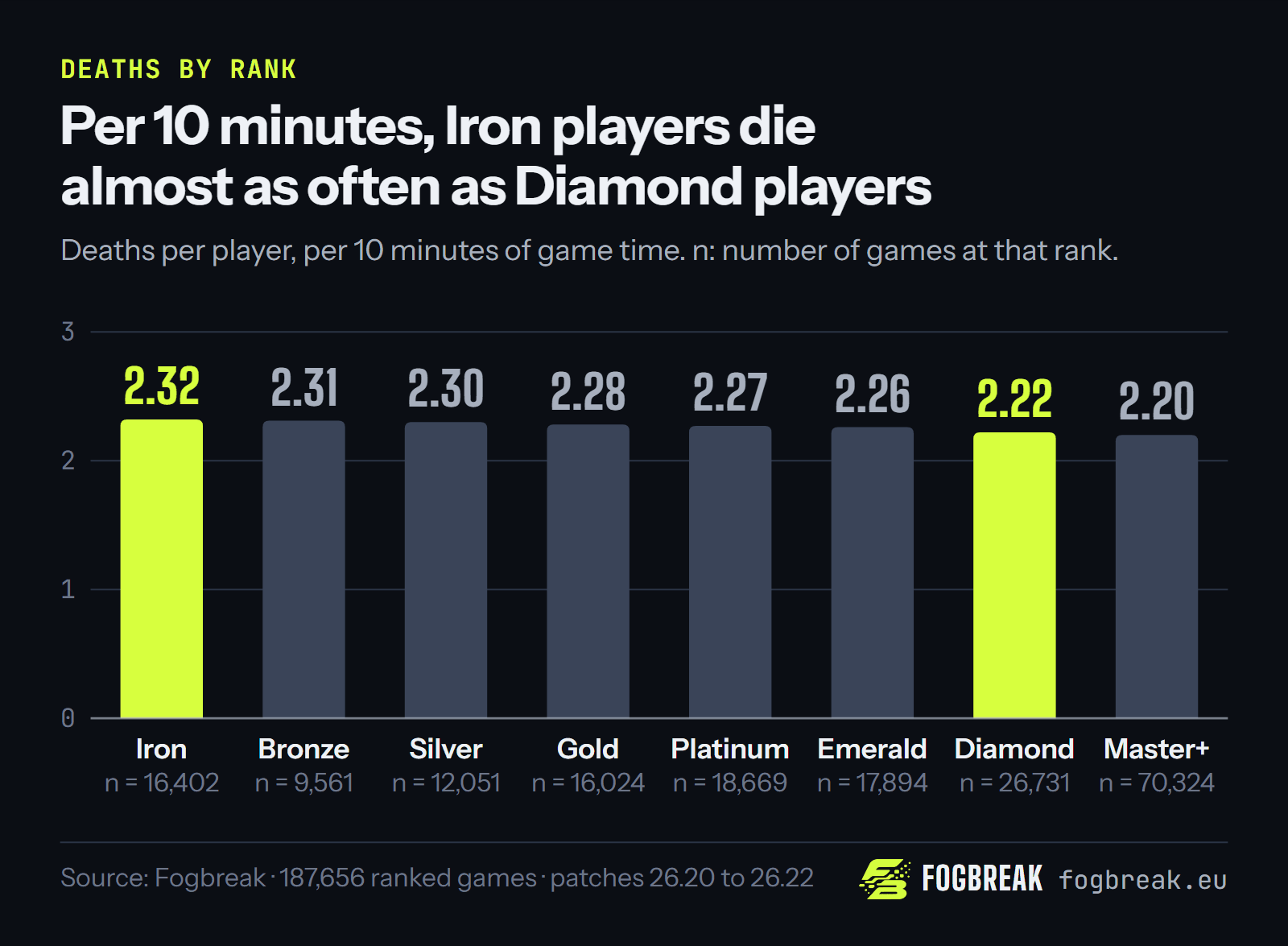
You end the game with a death column you’d rather not look at, and the lesson writes itself: “I need to die less.” It’s the most common advice in League of Legends, and surely Diamond players die way less than you do. We counted. They barely do. What changes as you climb isn’t how often you die. It’s what those deaths cost.
The rule
Stop counting your deaths. Count the ones that gave the enemy an objective.
Do higher-ranked players really die less?
Per game, a little: 7.00 deaths per player in Iron, 6.29 in Diamond. But games get shorter as you climb (30.2 minutes on average in Iron, 28.4 in Diamond). Adjust for game length and the gap is 0.1 deaths per 10 minutes: 0.3 over a 30-minute game.
Dying less still goes with winning: Iron through Diamond, a player on the winning team dies 5 times (median), a player on the losing team 8 times (7 in Diamond). Deaths say a lot about how a game ended, almost nothing about rank. “Die less” is vague advice: it doesn’t say which deaths, or when. What really separates ranks shows up elsewhere, in farming for instance (see How much CS at 10 minutes for your rank?).
Which deaths hurt the most?
We sorted every death with the same code Fogbreak’s post-game debriefs use. In Silver, here’s the win rate by how many deaths of each kind a player had in the game:
In Silver
0 in the game
1
2 or more
Died with no teammate in the fight
68.5%
55.3%
40.2%
Died outnumbered
67.7%
50.8%
34.3%
Died again within a minute of respawning
67.9%
45.6%
28.1%
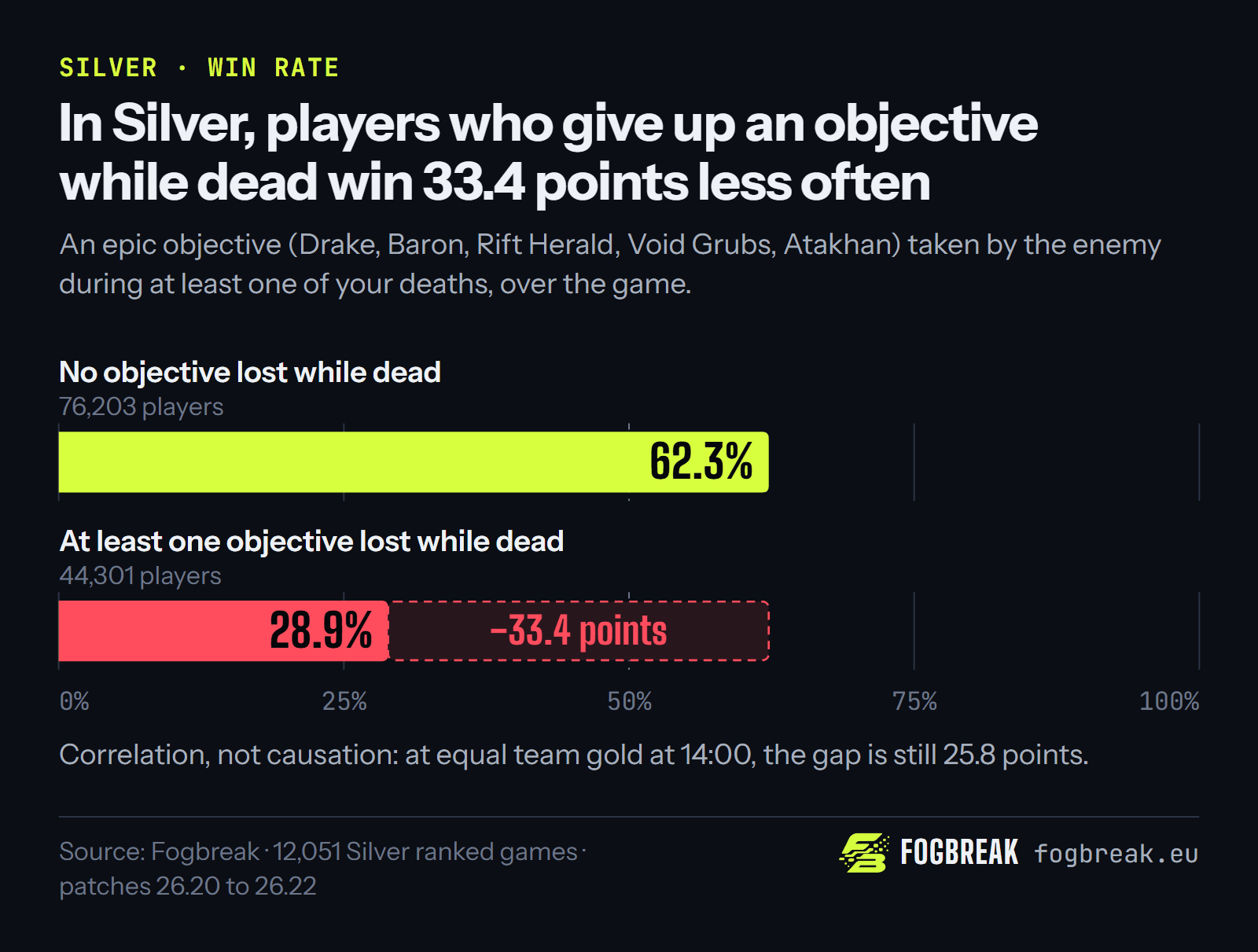
Enemy took an objective while you were dead
62.3%
32.8%
19.8%
One death of that last kind and the win rate drops 29.4 points. No other kind of death costs as much on its own. And it’s not rare: 36.8% of Silver players have at least one in a game.
Correlation, not causation. A team that’s already losing dies more and loses more objectives. At equal team gold at 14:00 the gap shrinks, but it’s still 25.8 points in Silver.
And it’s not a low-elo problem: 34.3% of Iron players have at least one of these deaths, 35.1% of Diamond players, and the win-rate gap runs from 32.1 to 33.8 points, Iron through Diamond. More than one player in three makes it, at every rank, and it’s expensive everywhere.
Why it hurts so much in game
While you’re dead, your team plays 4v5 around the pit: the enemy can start Drake or Baron without much fear of a contest. In Silver, 53.6% of Drakes and Barons go down while at least one player on the team losing it is waiting to respawn, when at any random moment a team has someone dead 44.8% of the time. With two dead: 26.5% of objectives, against 17.6% of the time.
The game moment
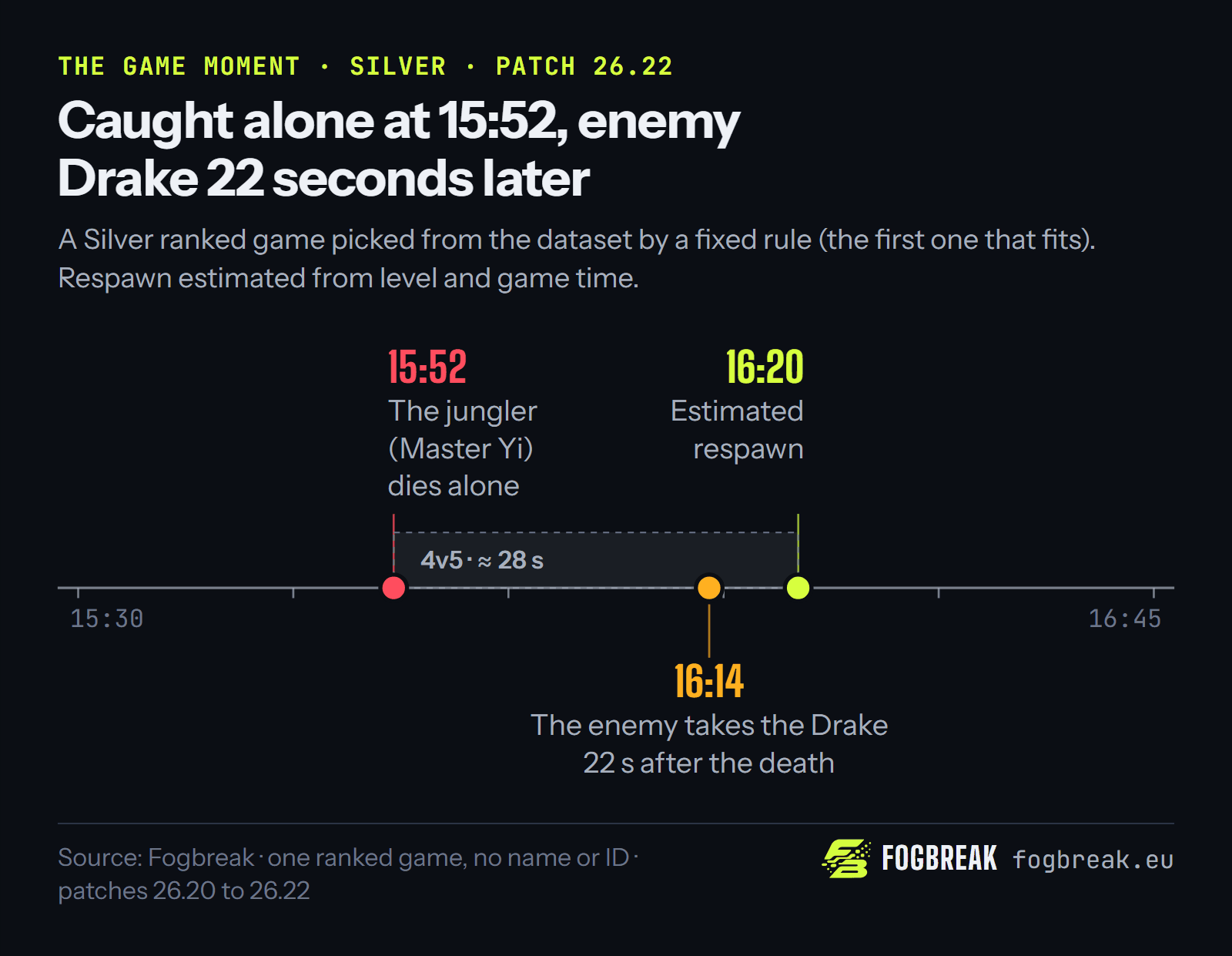
A Silver game from patch 26.22, picked from the dataset by a fixed rule (the first one that fits). At 15:00, the jungler’s team is 933 gold behind: still anyone’s game. At 15:52, the jungler (Master Yi) gets caught with no teammate in the fight. 22 seconds later, the enemy takes Drake.
Their team loses. One death doesn’t make a loss, and they died 11 times that game. But the one at 15:52 is exactly what the rule is about: dying alone, right before an objective.
Wandering off alone. Deaths with no teammate in the fight are the biggest share of deaths in Silver: 28.4%. Two in a game and the win rate drops to 40.2%.
Running straight back into the fight you just lost. 28.1% win rate in Silver with two or more deaths within a minute of respawning. The counting heads concept shows how to read the map before you walk back in.
Fighting 4v5 “because Drake is up.” 34.3% win rate in Silver for players who died outnumbered twice or more.